In the writing loop

This week will be our last meeting of the autumn term and it will be an opportunity to do some writing together to explore our further thoughts about Adrienne Rich’s reflections on critical pedagogy in times of crisis. Whether you were able to join our last meeting or not, please do feel welcome to join us for this session where we will guide you through an easy, iterative loop writing exercise.


If you would like to join in, you will find the Rich reading at https://cuny.manifoldapp.org/read/what-we-are-part-of-teaching-at-cuny-1968-1974-part-i/section/cd9438a6-c9f4-408f-95a8-d0752a6fb3be
Our discussion was focused especially on the section ‘NOTES, STATEMENTS & MEMOS ON SEEK, BASIC WRITING & THE INTERDISCIPLINARY PROGRAM (1969–1972)’

To take part in discussions or just stay informed about the Reading Group meetings and our other events please do subscribe to our mailing list at: https://www.jiscmail.ac.uk/cgi-bin/webadmin?SUBED1=CPG&A=1

Claiming Criticality

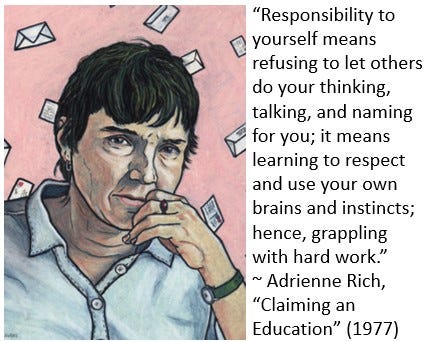
In 1977 the poet and educator, Adrienne Rich gave a convocation speech at Douglass College in which she reminded her audience:

If university education means anything beyond the processing of human beings into expected roles, through credit hours, tests, and grades (and I believe that in a women’s college especially it might mean much more), it implies an ethical and intellectual contract between teacher and student. This contract must remain intuitive, dynamic, unwritten; but we must turn to it again and again if learning is to be reclaimed from the depersonalizing and cheapening
pressures of the present-day academic scene (‘Claiming an Education’).

This year in the reading group we are taking our cue from Rich’s still resonant words to think about what generative AI means for critical pedagogy in 2025. All of us, students and teachers alike, are still trying to get to grips with how technology has or has not changed the meaning of a ‘basic’ skill in university education. Do we need to learn to do things without AI to ensure we understand and think for ourselves? Or, should we be integrating automated processes and automating tools into our work to create time to focus even more on ‘higher’ level skills, such as critical judgment and analysis? Technology optimists regularly promise us that automating basic processes leaves us free to focus on critical ones, but we all also know that we use our smartphones to scroll Insta or go shopping at any time of the day or night, rather than using our freed up time to read more books or actively reflect on the world we want to build. What does it mean to claim an education in 2025 when there are so many attempts to automate, depersonalize, and commodify teaching and learning?

If you would like to take part in this year’s discussions or just stay informed about the Reading Group meetings and our other events please do subscribe to our mailing list at: https://www.jiscmail.ac.uk/cgi-bin/webadmin?SUBED1=CPG&A=1

Within/Without the University

The Radical Open Access Collective (ROAC) has recently published an experimental booklet on how we can respond to the neoliberal university through our publishing activity as critical researchers. Taking its starting point from the exploitative and managerialist conditions of academic labour, it works towards publishing practices that “assemble, support, and mobilise modes of thinking and being together”(Publishing Activism 6).

The booklet, Publishing Activism within/without a Toxic University, is free to print and access here: https://works.hcommons.org/records/jg2as-46424#description-heading

Our group discussions are always focused on pedagogical questions, but clearly our work as active and publishing academic writers is deeply entangled with the same logics that interrupt and capture our teaching. We would be interested to hear any insights the booklet generates for you in the comments.

Learning and teaching coloniality in the present: CPG Annual Lecture 2025

About the event

The Critical Pedagogies Group annual lecture this year will take the form of a roundtable panel discussion. Scholars, educators, and students will come together to discuss the realities of coloniality in higher education today. The panellists will explore how decolonial work is understood, the challenges of institutional resistance, and the role of student-academic collaboration in advancing social justice.

The roundtable will be part of a launch event for the ‘Unpacking the Curriculum: A decolonial enquiry’ report, which you can read about here: https://blog.westminster.ac.uk/psj/tools/survey/

How, where, and when to attend

This year’s lecture will not be livestreamed or recorded. If you would like to attend the in-person event, please register using this TicketTailor linkhttps://www.tickettailor.com/events/studentpartnershipuow/1642755 You will receive an email before the event with specific room information.

The panel discussion will be held on April 8th, from 5-7 pm at the University of Westminster Regent Street Campus (309 Regent St., London W1B 2HW) You can find information about the location and access details at: https://www.westminster.ac.uk/about-us/visit-us/regent-street

About the panellists:

Carol Tellez Contreras (she/her) is an Indigenous queer Bolivian Law student. Living in Europe, she has faced issues with colonial thinking that prevails, which affected her views of her identity. This emphasised her interest in issues surrounding decolonisation, anti-racism, and intersectionality. Her legal studies have made her even more aware as to how these issues are present through legal systems and institutions. 

Kelsea Costin (SOAS) is a research assistant for the Pedagogies for Social Justice Project (PSJ). Her most recent publication on student and staff perceptions on decolonising the curriculum has appeared in a special edition centring social justice and pedagogical partnership in Social Sciences. As part of a student-staff collaboration, Kelsea believes that relationality and student-staff partnerships are crucial for dismantling institutional structures and challenging coloniality in the academy.

Kyra Araneta (she/her) is a Lecturer in Student Partnership and Social Justice in the Centre for Education and Teaching Innovation (CETI) at the University of Westminster. Her research focuses on decolonial pedagogies, social justice education, storytelling and the role of student-staff partnerships in fostering ethical learning environments. As a mixed woman of African-Asian descent, Kyra dedicates her praxis to challenging contemporary forms of coloniality in academia, centring underrepresented and marginalised voices, and advocating for anti-racist and decolonial learning spaces.

Mrinalini Greedharry (University of Essex) has been having conversations about colonialism in Canadian, Finnish, and British university classrooms for about thirty years now. She is interested in how people understand themselves through colonial systems and re-imagine themselves through colonial critique. You can contact her at mrinalini.greedharry@essex.ac.uk

Onni Gust is Associate Professor in History at the University of Nottingham. They teach transgender history and histories of race, gender and sexuality in colonial context, mainly focusing on the ‘long’ eighteenth century. Their book, Unhomely Empire: whiteness and belonging, 1760-1830 was published in 2021. Onni is currently working with natural history museums and artists on a new research project, ‘Kin: transgender history with and beyond the human’ looking at what it means to write transgender history in the context of climate catastrophe. Their article, ‘Of mermaids and monsters: transgender history and the boundaries of the human in the eighteenth- and early nineteenth-century Britain’ begins to address this question.

Criticality by any other name

At our last meeting there was a lively discussion about what the increasing social and political pressures on scholarship that uses words like diversity, race, inclusion, and gender might mean for members of our group.

One strategy is to swerve around the words that are being flagged as problematic by using apparently ‘neutral’ language to describe the research we have been doing, and will continue to do, on oppressive systems and practices in higher education. It demands extra work from us, as scholarship and teaching from and about marginalised positions has always done, but that is not going to stop us from saying what is actually happening in the world and our classrooms. There are always time and places in which you have to choose words that will slip by the gatekeepers.

Another strategy is to use even stronger and plainer language. Words like diversity and inclusion are everywhere, but even words like intersectionality and decolonization have arguably been captured by university managers and techniques of bureaucratization. The profusion of committees, charters, guidelines, brochures, and mission statements about the contemporary university’s commitment to various forms of inequality signal some kind of recognition that we need to be talking about these issues. However, research-informed accounts such as Sara Ahmed’s On Being Included, now already 13 years old, note that such work remains largely symbolic, however much energy minoritised scholar-teachers pour into it. In this context, perhaps it would be good to move on from using the words that have already been captured and weakened by university discourse and start talking more directly and plainly about racism, sexism, ableism, homophobia, classism, and transphobia. Words like ‘diversity’ or ‘inclusion’ increasingly do the work of obscuring the violent and specific ways university systems and practices actively reproduce inequality.

One of the most interesting strategies is to be even more creative with language, drawing on obscure or culturally specific meanings of existing words to do other kinds of thinking. This is a practice marginalised peoples have always drawn upon to use dominant languages to do their own thinking. Sometimes this has meant reclaiming words used to objectify and humiliate them, using the master’s language to do things the master never dreamed of in his philosophy. And often such deft play with language produces beautiful and profound meditations on human existence through its sheer defiance.

In our discussions at the Critical Pedagogies Project we are always searching for these creative strategies of resistance, what one participant in the last meeting described as the capoeira of pedagogy. We invite you to share your ideas about the language we could use to continue doing the work that matters to us — whether you want to make a case for coining new words, reclaiming old ones, or bringing culturally specific uses of words to a larger community, let us know how we could dance with you.

Building our critical community

Thank you to all of you who have spent time this year building the critical pedagogies project with us. We know the demands that the colonial capitalist university makes on your time and are so heartened by the fact that you push back by spending time with us!

Special thanks go to Caitlin Heppner, who gave this year’s annual lecture ‘Tethered to the grid and rendered intelligible’. If you missed Caitlin’s lecture, you can now listen to it through the website here. Remember that you can always catch up on past lectures, whether as a teaching or research resource, by listening to the online archive.

Thank you also to Annapurna Menon, who led us through a critical, joyous, and restorative afternoon of zine-making last week. Annapurna’s workshop brought our year to a hopeful and energetic end.

Over the summer Dale, Jennifer, and Mrinalini will be planning next year’s readings, lectures, and workshops. If you would like to suggest topics or readings for the reading group, speakers for the annual lecture, or facilitators for the summer workshop, please do let us know in the comments. Our aim is to educate ourselves about critical practices that help us build a different kind of university than the one we have now. If you know of practices, thinkers, texts, podcasts, art, or anything else you think we should be reflecting on, please do share!

July on fire

In case you missed our earlier announcements, or, even better, an exciting window opened in your July for zine-making and creative destruction of the university, there are a few places left to book on our Zine-making workshop https://buytickets.at/studentpartnershipuow/1223825

The workshop will be facilated by Dr Annapurna Menon on July 10th, 1-4 pm, at the University of Westminster, Cavendish campus in London.

See you there!

Our zine-making workshop is back!

As regular readers of the blog and listserv members will know, we had to re-schedule our spring zine-making workshop to July 10th, 2024. The workshop will take place at the University of Westminster Cavendish campus from 1-4 pm.

You can now book your tickets to the workshop at https://buytickets.at/studentpartnershipuow/1223825

In the ongoing atmosphere of redundancies, restructuring, and cuts in higher education, it is more important than ever that we continue to come together and craft our vision of the university we want. Our theme for the afternoon is the creative destruction of the university. You can read more about how we came to be thinking about this in our previous post.

The workshop will be facilitated by Dr Annapurna Menon (she/her), who joined the Department of Politics and International Relations at the University of Sheffield in September 2022. Her doctoral research focused on the coloniality of postcolonial nation-states, specifically studying the Indian nation-state’s exercise of power in Indian-administered Jammu & Kashmir. She has also published on topics relating to Hindutva, right-wing politics, decolonial theory militarisation and gender; activism and pedagogy as an activist tool. She enjoys learning with and from students, colleagues and friends, and believes that critical engagement in all academic and activist spaces is very important right now.

Tethered to the Grid and Rendered Intelligible: CPG Annual Lecture with Caitlin Heppner

We cordially invite you to attend this year’s annual lecture, which will be delivered by Caitlin Heppner (University of Ottawa). The lecture begins at 4 pm on June 6th, 2024.

Tickets for attending in person or via live-streaming are available to book now at: https://buytickets.at/studentpartnershipuow/1231625

Tethered to the Grid and Rendered Intelligible

Algorithmic processes are increasingly tasked with normative evaluation within state infrastructure, answering questions like: who is a criminal, where crime is likely to occur, and which family homes are safe? In answering these questions, algorithms classify and constrain subjects through the co-creation of kinds of people. This algorithmic creativity tends to bury both social construction and moral evaluation under the guise of natural classification: a cataloguing of so-called natural properties legitimized by the authority of “The Algorithm.”

In the spirit of Michel Foucault, my work aims to unveil the role of power in the algorithmic construction and control of people. I examine three algorithmic systems to demonstrate how the veiling of social and contingent classifications tricks us into believing that these kinds are natural, and therefore so too is the ordering of these kinds. The algorithmic political order is portrayed as simply the natural order of things: there can be no other way. This is the threat of the algorithmic state. By automating normative evaluation—the identification of who might be a criminal or a terrorist, of where dangerous neighbourhoods are, or of what makes a good home—we are denied the possibility of thinking and doing otherwise.

About our speaker

Caitlin Heppner is a PhD student in philosophy at the University of Ottawa in Canada and a researcher at the Canadian Robotics and Artificial Intelligence Ethical Design Lab. Her co-authored in-development work includes a “Critical Research into Tech” toolkit for navigating the risks of critiquing Big Tech, a bioethics framework for the public testing of AI, and a series of storytelling modules for ethically conscientious design. This applied work is motivated by the skeptical intuition that nothing should be done simply because it has always been done.

How to find the lecture: The lecture will be held at the University of Westminster, Marylebone Campus. Full travel and access information can be found at: https://www.westminster.ac.uk/about-us/visit-us/marylebone

Spring Critical Pedagogies Workshop – Sign up!

Tickets are now available for our spring zine-making workshop at https://buytickets.at/studentpartnershipuow/1223825

We invite you to join us on May 8th, from 1-4 pm at the University of Westminster’s Cavendish campus, for an afternoon of thinking, playing, and making zines together. Our theme for the afternoon is the creative destruction of the university. You can read more about how we came to be thinking about this in our previous post.

The workshop will be facilitated by Dr Annapurna Menon (she/her), who joined the Department of Politics and International Relations at the University of Sheffield in September 2022. Her doctoral research focused on the coloniality of postcolonial nation-states, specifically studying the Indian nation-state’s exercise of power in Indian-administered Jammu & Kashmir. She has also published on topics relating to Hindutva, right-wing politics, decolonial theory militarisation and gender; activism and pedagogy as an activist tool. She enjoys learning with and from students, colleagues and friends, and believes that critical engagement in all academic and activist spaces is very important right now.

If you aren’t already subscribed to our email list, now is also a good time to sign up for early announcements about our workshops, annual lectures, and reading group meetings. You can sign up for these at: https://www.jiscmail.ac.uk/cgi-bin/webadmin?SUBED1=CPG&A=1